
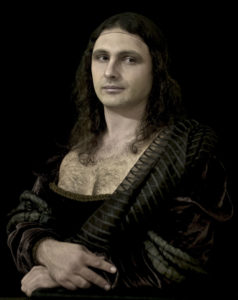
(Mona Lisa) (2003). It situates the work within art history and feminist theory, comparing it to Leonardo da Vinci’s Mona Lisa and later reinterpretations. The essay argues that Karalla’s version both references and subverts the original: it preserves Renaissance-like dignity while replacing the female subject with a male model, thereby questioning fixed ideas of gender, beauty, and representation.
It highlights how the photograph’s composition, lack of background, and focus on the figure draw attention to psychological presence rather than setting. The analysis also explores how the work engages with “alchemy” as a metaphor for personal transformation and empowerment, while critiquing traditional visual “focus” in photography as tied to power and representation.
Ultimately, the essay concludes that Karalla’s Mona both belongs to the long lineage of Mona Lisa reinterpretations and stands apart by using gender transformation to expand and destabilize conventional ideas of beauty, identity, and authorship.
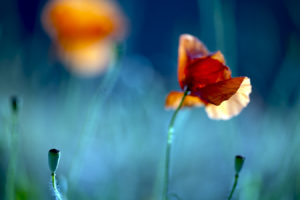
After the death of a dear friend left her devastated, Karalla lay in the dirt and photographed the Italian poppies. Their red petals became elegies—reminders of fallen soldiers and of the grief borne by families after war, a grief she recognized as her own.
In these fields exists a hidden world of delicate beings, unnoticed by the common eye, dismissed merely as flowers. Yet in Karalla’s lens they become a community: sentient presences, vulnerable bodies, witnesses. Photographed before the sun cast its glorious light across the earth, these images were discovered in the Murgia of the Sassi di Matera, Italy, where dawn reveals a fragile theater of remembrance.
The poppies hold poses like portrait sitters; some seem to return from battle, carrying the exhaustion of history. Others gather in tight clusters like families bound by love and survival. Their forms resemble living tapestries that tell histories of loss, resilience, and collective memory.
Lying in the dirt to unlock this visual magic, Karalla meets them at their level—not above them, but among them—sharing their beauty, hearing their silent stories, waiting as the sun lifts the night’s dew from their bodies. In this intimate act of witnessing, flowers become mourners, soldiers, families, and spirits; the field becomes both memorial and living archive.
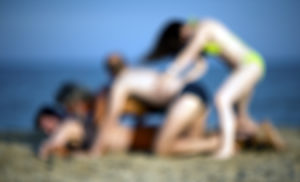
The Italian Bathers
It was my f/2 summer, the aperture fixed on a single tree branch, a quiet frame through which the life of the Motoponto seaside unfolded. Beyond that point of focus, families and solitary figures drifted through the image softly out of focus—bathers, wanderers, fleeting presences suspended in light.
By allowing the world beyond the branch to blur, the camera held onto something more elusive than description: the atmosphere of happiness itself. Leisure became apparition. Bodies became gestures. The seaside was transformed into a field of luminous anonymity, where joy could be witnessed while privacy remained intact.
These images were filmed in a still form, where softness was not concealment but tenderness—an ethics of looking. The out-of-focus figures hover between memory and disappearance, as if summer itself were dissolving while being held.
Through a shallow depth of field, the ordinary rituals of the Italian shore become almost cinematic: a meditation on pleasure, distance, and the fragile beauty of lives glimpsed but never possessed.
Romance is not love but a mechanism of perceptual gaslighting.
A blur. A seduction of consciousness.
It does not reveal reality—it edits it. It softens contradiction, beautifies absence, and makes abandonment shimmer as destiny. In romance, longing becomes an accomplice, conspiring with memory and fantasy to forge counterfeit truths. Projection masquerades as devotion. Desire impersonates prophecy.
What we call romance may be less an encounter with another than a misrecognition of the self, reflected through hunger. A willing hypnosis. A consensual delusion. We enter the exquisite lie knowingly, allowing enchantment to distort the brutal architecture of time, loss, and impermanence.
Romance gaslights by making instability feel eternal, by turning uncertainty into fate, by persuading us that what flickers is what lasts. It is emotional fog mistaken for revelation.
Love may begin where this blur dissolves.
Romance begins in the blur.
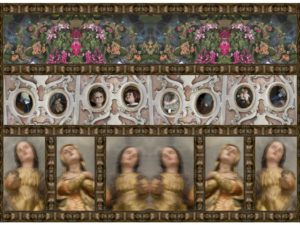
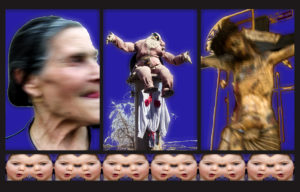
Inteligent Design; Fruits, Meats and Babies – Sketches – Angels
Karalla creates expansive tapestries that recall the great historical weavings—monumental surfaces that once told the histories of kingdoms, wars, myths, and divine judgment. But these are tapestries of another order, composed through collage of fresh vegetables, luscious rotten fruit, animated and unanimated bodies, fragments of Christian painting, and edible or inedible flesh, woven into dense fields of seduction and ruin. They carry the look of tapestries that narrate history, yet the history they tell is one of decay, excess, and impending collapse.
At first encounter they radiate an innate beauty, almost baroque in their abundance; on closer inspection they begin to disturb. Who dares to look closer? Are these rich tapestries screaming at you, or gloomily hanging on the wall to be hedonistically consumed?
From a distance, decay resolves into harmony. Maggots become texture, spoiled fruit becomes ornament, decomposition becomes pattern. What appears abject transforms into a sublime visual order, a feast staged at the edge of collapse. These works inhabit the language of vanitas while expanding into something epic—history painting transformed into a woven apocalypse.
As the planet decays under human intervention, Karalla’s tableaux become allegories of a cursed world—one governed by a sanctimonious ruling class exploiting ideology to deceive the people. Rot is no longer metaphor alone; it is political atmosphere. The sumptuous surfaces operate like traps, drawing the eye with beauty before revealing corruption embedded within abundance.
Like ancient tapestries chronicling empires in ruin, these works record the mythology of a dying age. Flesh, fruit, theology, insects, and refuse merge into a theater of consumption in which the viewer is implicated. This may be the closest thing to apocalypse you have ever seen—not as spectacle of destruction, but as history unraveling in real time, woven before your eyes.
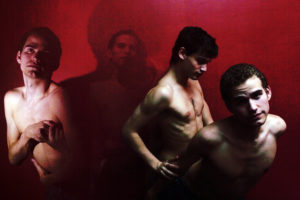
To make a project while sleeping seemed, at first, an elegant proposition: if the camera could work while I surrendered to unconsciousness, the labor of image-making would be complete by morning. The fantasy was automation through absence. I woke to failure. Attempt One.
Rethinking the mechanics of photography, I returned to its primal condition: light as origin, light as event. At midnight, when the world dissolved into darkness, another experiment emerged—an open shutter, my body in motion, bursts of flash interrupting the void. Images appeared, but sleep did not. Crawling into bed at five or six in the morning, exhausted yet awake, I understood this too as failure. Attempt Two.
Then came the construction of an artificial night: a lightproof chamber built for daytime darkness, 112 inches long, 55 inches wide, and 48 inches high. A private black box, part camera obscura, part shelter, part laboratory. I entered with tripod, camera, and flash, sealed inside the structure to test whether darkness itself could become a medium. After thirty exposures I emerged to examine the results. There was nowhere for the light to travel; the image collapsed into enclosure. Failure again. Attempt Three.
Abandoned as apparatus, the box became sculpture. Its surface gathered packages from daily commerce, a mute monument to collapsed ambition. Yet it began generating another kind of activity: conversation. Visitors fixated on the object—What is it? Did it work?—and from these questions the work mutated.
The failed machine became a social chamber.
Friends entered the darkness for improvised group sessions, moving blindly through the enclosed void. Neither subjects nor photographer knew where the flash would strike or what it would disclose. Chance displaced authorship. The image was no longer composed but encountered, arriving as an accident shared by all participants. What began as a search for sleep became an experiment in collective uncertainty, with darkness itself as collaborator.
Everyone was left in the dark. And I still was not sleeping. Failed Attempt Four.
What began as a pursuit of rest became a project about the productive force of failure—where each breakdown generated a new proposition, and each ruined experiment opened another threshold. Sleep never arrived, but the work did.