

Communion Host
In this work, the communion host—an object traditionally associated with purity, devotion, and ritual consumption—is used as a fragile site of inscription and rupture. Onto its surface I draw fragmented sexual scenes with a marker, introducing immediacy, instability, and the hand of interruption into something meant to signify transcendence.
The host becomes a paradox: both sacred and disposable, ceremonial and violated, edible yet image-bearing. By marking it, I collapse boundaries between the spiritual and the bodily, the revered and the repressed. The drawn interventions do not aim for depiction in a literal sense, but rather for contamination—images that behave like memory, impulse, or cultural residue pressed into a surface designed to erase individuality.
The marker line functions as a refusal of polish. It is direct, irreversible, and temporally present. It resists the distance usually granted to religious objects, pulling them back into the messiness of human desire, perception, and contradiction.
This work asks what happens when an object of ritual consumption is no longer passive. When it is no longer untouched. When it becomes a field where taboo, belief, and embodiment are forced to coexist in uncomfortable proximity.
Ultimately, the piece is not about destruction of the sacred, but about revealing how fragile the boundaries are between sanctity and the lived, physical imagination.
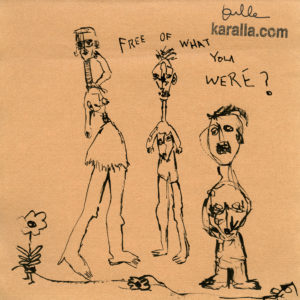
Brown Bag Doodles
Brown Bag Doodles exists because the conscious voice is already compromised. It is trained, edited, socialized, and constantly performing coherence. What gets pushed aside—hesitation, contradiction, private logic, irrational tenderness—doesn’t disappear. It leaks. The brown bag is simply the first surface willing to receive that leak without demanding it become “work.”
The point is not expression. The point is interception.
These doodles are made in the gap between thought and self-editing, where language is still closer to sensation than narrative. They refuse resolution. They don’t aim to be understood cleanly, because clarity is often the first form of control.
The deeper “why” is this:
we live inside systems that increasingly ask us to function like objects—consistent, useful, predictable. Emotional life gets reorganized into performance categories: partner, worker, friend, brand, self-image. Even intimacy begins to inherit the logic of maintenance.
So the doodles interrupt that logic at the smallest scale possible.
When one reads: “I like the idea of being friends first… not like some stove in your kitchen that has to work,” it is not about relationships as much as it is about resistance to instrumentality—the refusal to be reduced to function, even in love.
The brown bag becomes a quiet refusal of optimization. A place where thought is allowed to be unfinished, nonproductive, and sometimes illogical on purpose. Not because it is broken—but because it is still human before it is useful.
In that sense, the work is not about revealing the subconscious.
It is about protecting it from being corrected.
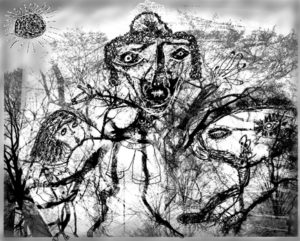
Dodging & Burning the Photography
Dodging & Burning the Bogey Man
Dodging and burning in photography traditionally happens in the darkroom—lightening and darkening selected areas of an image to shape attention, atmosphere, and emotional weight. I translated this analog gesture into Photoshop, extending a physical practice into a digital one.
But the logic of light manipulation predates the darkroom for me.
As a young girl, I had eleven windows in my bedroom. Across from my bed stood a large tree that filled five of them. Every night, in its shifting branches and shadows, I would see the bogey man. That tree became my first projection surface—an early screen where fear and imagination collaborated.
In revisiting photography, I realized I was still doing the same thing: dodging and burning not only images, but perception itself. I was lightening what I could bear to see, and darkening what I needed to transform. The bogey man reappears not as a literal figure, but as an inherited shadow embedded in how I construct images.
Photography becomes a space where childhood vision, digital manipulation, and emotional memory overlap—where I learn to edit fear into form.