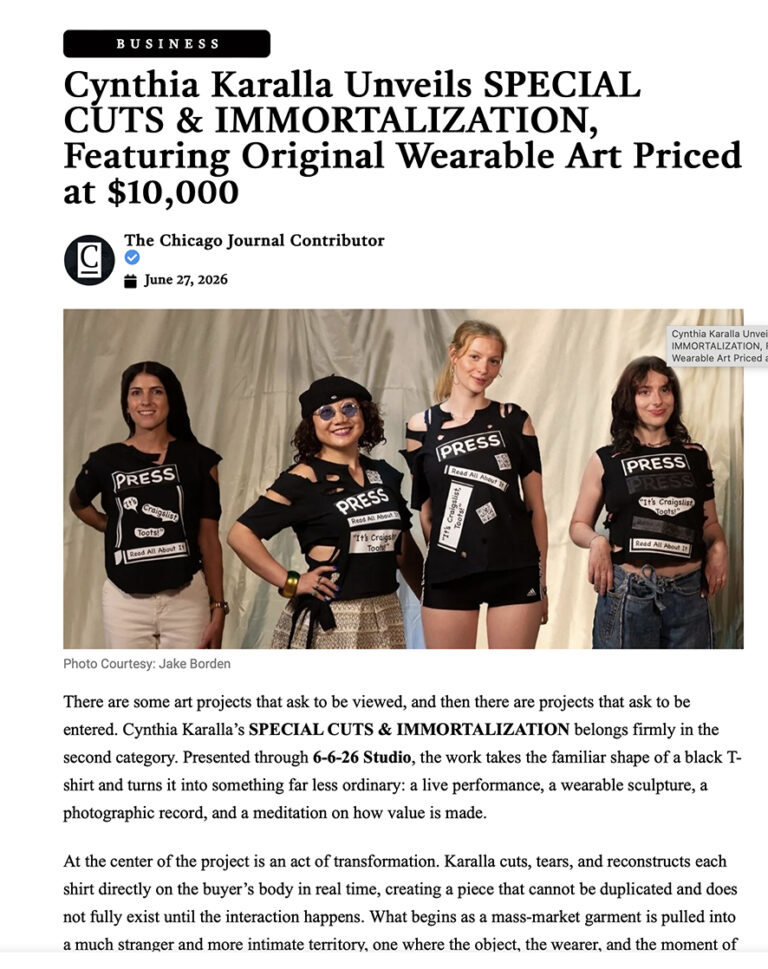
An experimental conceptual art project begins when the artist wears QR codes on shirts linking strangers to her website, turning the body into a mobile exhibition. After discovering people secretly scan the code and then introduce themselves, the idea expands into a larger intervention inspired by “art for the masses.”
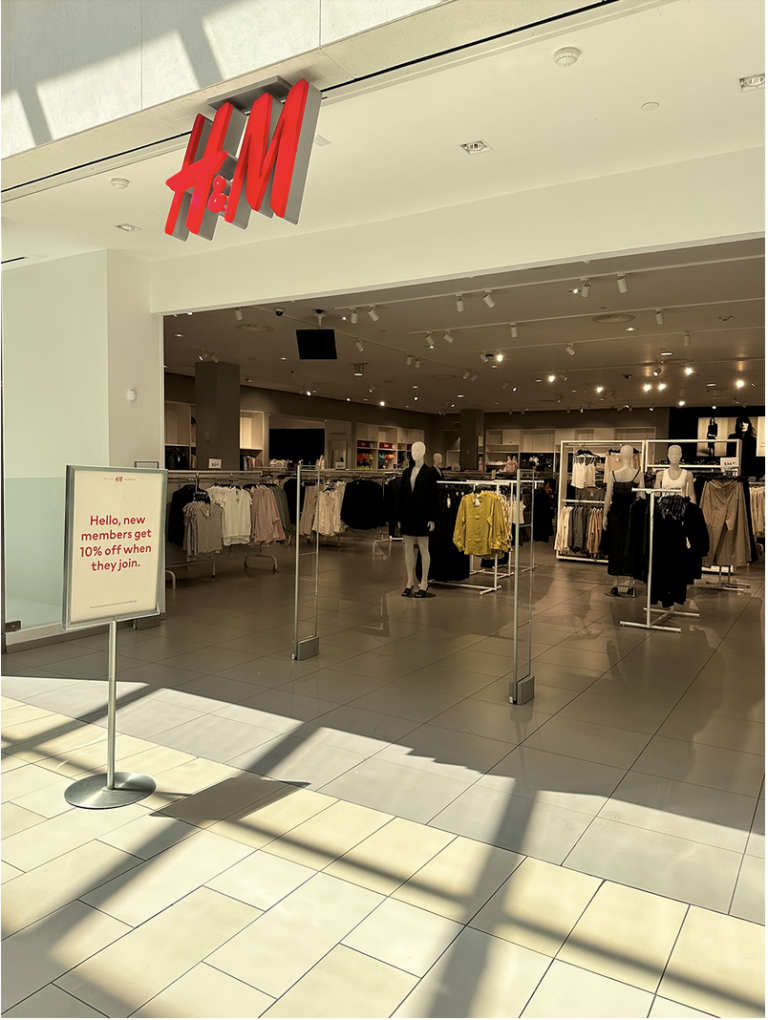
I buys 18 white H&M shirts, transforms them into signed and numbered artworks with QR codes, and secretly placed them back onto store racks across New York City for unsuspecting shoppers to find and own. Blending humor, risk, social commentary, and guerrilla performance, the project hijacks retail space as exhibition space and turns everyday consumers into accidental collectors and participants in a living artwork.
The Robin Hood ART Project as equal parts intervention, prank, social sculpture, and conceptual performance.
At its core, it begins with a simple experiment: turning my body into a moving exhibition by wearing QR codes linked to my website. But the project escalates when the QR code shirt stops being personal promoted and becomes redistribution—art is smuggled into everyday commerce.
“the backwardness of non-stealing.” To become a guerrilla retail intervention in which art is redistributed through the circuitry of fast fashion.
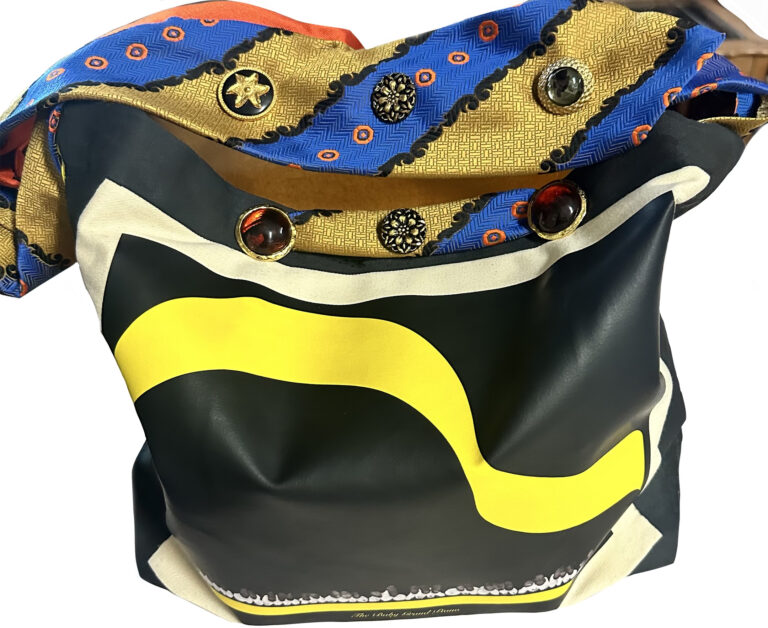
THE SEMREH BAG — ANTI-LUXURY / THE COMMODITY CONFESSES
Karalla does not make handbags; she stages breaches in the image regime.
These works seize the handbag—commodity fetish, gender script, status monument—and turn it against itself. In opposition to the sanctified aura of the Hermès bag, Karalla introduces contamination: flaw, rupture, excess, residue. The hand refuses disappearance. What luxury suppresses—labor, decay, class violence—returns as surface.
A painted piano mutates into phallic repetition, where masculine authority collapses into parody through excess. Desire is pushed until it reveals itself as machinery. The image does not depict patriarchy; it short-circuits it.
The shoulder strap, constructed from men’s silk ties, cannibalizes the costume of corporate power. Symbols of authority are made to carry
the object that undoes them.
These are not fashion objects but counter-fetishes: commodities turned unstable, seductive surfaces rerouted into critique.
Luxury becomes evidence.
The handbag becomes accusation.
Drawing on the logic of Barbara Kruger, Martha Rosler, and Louise Bourgeois, the work treats fashion as ideological apparatus and ornament as social control—only to sabotage both from within.
A handbag becomes a strike in object form.
A fetish becomes a counter-image.
The commodity confesses.
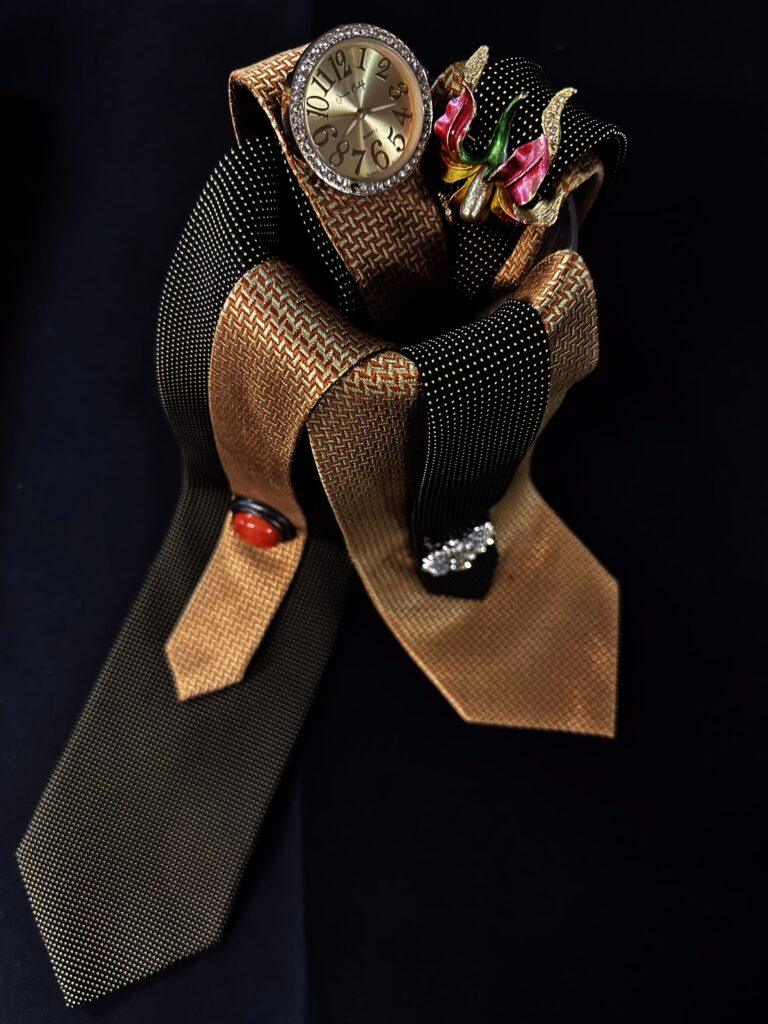
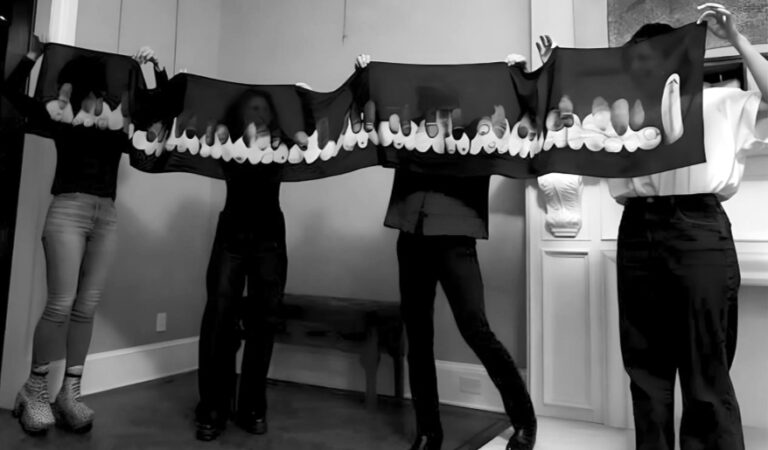
The Baby Grand Piano /Silk Scarf
The Baby Grand Piano is a large-scale photomontage composed of 88 photographed penises—52 white and 36 black—digitally assembled into the form of a 72-inch piano keyboard. Over a two-year period in Southern Italy and New York City, Cynthia Karalla studied the physical construction of a piano and produced nearly 20,000 photographs in order to build the seven octaves of the instrument.
In The Baby Grand Piano, Karalla investigates one of society’s enduring taboos: the penis. In many cultures it remains obscured by shame, silence, or discomfort—something hidden from public conversation and visual discourse. By transforming the body into the architecture of a musical instrument, Karalla asks viewers to reconsider their conditioned relationship to the subject. The work challenges assumptions surrounding beauty, masculinity, race, sexuality, and censorship while shifting the penis from an object of secrecy into one of formal composition and collective participation.
Women played a significant role in the realization of the project, often encouraging or bringing male participants to the work. The men themselves appear only as anonymous contributors, freed from identity, status, and class. Through this anonymity, the body becomes both individual and universal, dissolving distinctions between personal identity and shared human form.
For viewers, The Baby Grand Piano offers an opportunity to confront personal and cultural attitudes toward sexuality, including ideas surrounding circumcision, vulnerability, religion, and the contrast between rural Southern Italy and urban America. Karalla positions the work as an act of transgression—an encounter with imagery traditionally considered forbidden, but presented within a new aesthetic and conceptual framework. Referencing the biblical “forbidden fruit,” the work invites viewers to question why certain aspects of the human body remain culturally restricted while others are normalized.
Working between New York City and the rural region of Basilicata, Italy, Karalla often creates projects that rely upon direct community participation. These contrasting environments—one shaped by the freedoms and anonymity of metropolitan life, the other deeply rooted in Catholic tradition and social conservatism—form an essential tension within her practice. Participants are asked not only to contribute physically, but also to confront their own beliefs, cultural conditioning, and sense of identity within their communities.
Through collaboration, confrontation, and humor, The Baby Grand Piano transforms the taboo into dialogue, creating what Karalla describes as “a community of transgression.”

STONE WEAR
– In the early 1990s, I left the compressed velocity of Manhattan for the expansive sparseness of Crete, where time seemed to open rather than close. Against the density and psychic pressure of America, island life simplified the external world and enlarged the interior one. Immersed in the writings of Arthur Rimbaud, I found the terrain from which Comprachicoes in the Raw emerged.
The book became a poetic and philosophical meditation on social conditioning, spiritual rebellion, and the search for inner freedom—rooted in the belief that what we seek already exists within us.
Out of this same inquiry came the Stone Glasses: sculptural objects for reading, though not in the conventional sense. They function as a wearable metaphor for the book’s central proposition—that vision is inward. To wear them is to look through stone, through time, through self; not to read the world, but to read within.
Together, the book and the Stone Glasses form a single work: one written in language, the other in object, both asking how perception might become a path to awakening.
Conceptual Art Lineage — Manifesto Meets Artifact
Comprachicoes in the Raw operates as both manifesto and artifact: a written work of resistance paired with objects—the Stone Glasses—that extend its philosophy into material form. In this lineage, the book is not simply read but activated, and the object is not sculpture alone but a proposition.
Like much conceptual art, the work privileges idea as medium. Language becomes sculptural, metaphor becomes political, and the artifact functions as a tool for consciousness. The Stone Glasses are less an object to look at than a device through which to reconsider perception itself—to “read within.”
The project moves between memoir, poetic manifesto, social critique, and symbolic object-making, where art is not representation but inquiry. Its lineage touches artist books, performative objects, and conceptual practices in which thought itself becomes material.
“Manifesto meets artifact” works because it captures the dual nature:
- Manifesto — rebellious, philosophical, critical, declarative
- Artifact — found/constructed object carrying memory, ritual, and idea
The kinship with the tradition of artist-thinkers like Marcel Duchamp, Joseph Beuys, Antonin Artaud, and on pun with the visionary poetics of Arthur Rimbaud.